The recently concluded Kogi State Strategic Local Government Authority Leadership Dialogue marked a pivotal milestone in strengthening Primary Health Care (PHC) governance and sustainability at the grassroots level.
The programme was organized by the State Ministry of Health (SMOH) in collaboration with the State Primary Health Care Development Agency (SPHCDA) and IMPACT Project. In attendance were top Government Functionaries led by Secretary to the Kogi State Government, Heads of Health MDAs, Guest Speakers, Directors of the SMOH and SPHCDA, Directors of the Local Government Area (LGA) Chairmen, Directors of Local Government (DLGs), Directors of Primary Health Care (DPHCs) at the LGA level, LGA Supervisory Councilors of Health, Development Partners, Representative of the Traditional institution among other stakeholders.
Participants were updated on achievements under the IMPACT Project, including improved immunization coverage, reduced maternal mortality, disbursement of over ₦500 million as Performance Framework for LG Health Authorities operations, quarterly Direct Facility Financing (DFF) of N900,000 to support HFs operations, engagement of 220 Skilled Birth Attendants (SBAs) and 220 Medical Records Officers (MROs), strengthened Health Management Information Systems (HMIS) for completeness and timely data reporting and 88 PHCs upgraded and revitalized .
It was categorically stated that Nigeria’s health system is decentralized, with LGAs constitutionally mandated (under the 1999 Constitution and the National Health Act 2014) to lead PHC services. LGA leaders were tasked with conducting baseline assessments of PHC facilities (infrastructure, staffing, equipment, and utilization) and implementing regular reviews of service quality, drug availability, and community feedback.
Key gains of the event included heightened awareness for ownership of PHCs by LGA Chairmen towards sustainable financing, accountability and consolidation of gains from national and international interventions.
The expected outcomes will position Kogi State for accelerated progress toward Universal Health Coverage (UHC), reduced maternal and infant mortality, and improved health system resilience as donor support such as the World Bank IMPACT Project winds down.
Therefore, Local Government Chairmen are mandated to take full ownership of PHC facilities in their domains ensuring effective financing, staffing, equipping, performance monitoring and develop strategies for sustaining health gains post-donor interventions thereby bridging gaps from Policy to local action.
The dialogue emphasized transitioning from donor dependency by leveraging on the local government financial autonomy.
High points of the dialogue included:
Keynote presentations by Notable Health Professionals: Dr. Terfa Kene, President, Association of Public Health Physicians of Nigeria delivered a practical presentation on “The role of Strategic Leadership in Universal Health Coverage (UHC): from Policy to Local Action”.
Also Prof. Simon P.O. Akogu, Provost, College of Health Sciences, Prince Abubakar Audu University Teaching Hospital (PAAUTH) Anyigba dissected “PHC system Governance at State and LGA levels”.
Panel discussion were carefully selected Panelists representing the Academia, Local Government Service Commission, Development Partners (WHO and NPHCDA), State Health Insurance Agency and Local Government Chairmen exposed participants to “Strategies for sustainable Health Financing at the LGA level”.
Breakout sessions in 4 groups aimed at focusing on the projection where the state ought to be, where we are (present status) and recommend strategies for improvement towards the future. The breakout session topics were:
(i) Strengthening the Health Workforce: Recruitment and Retention
(ii) Expanding Community Based Health Insurance coverage (CBHI)
(iii) Getting PHCs to BeMONC standard: Benefits, what is required and the role of LGAs
(iv) Data documentation and reporting: A tool for informed decision-making for Local Health system.
Recommendations towards improving PHC system sustainability included revitalizing Ward Development Committees (WDCs), promoting “hybrid communities” (involving residents, stakeholders, and diaspora for resource mobilization), and expanding health insurance schemes.
furthermore, LGA Chairmen should prioritize allocation of dedicated budgets for PHC operations and maintenance, do regular facility supervision and community engagement, collaborate with appropriate State Agencies for manpower recruitment and training, monitoring and reporting on agreed targets through the peer-learning network.
Additionally, the State Government is expected to support these efforts with continued oversight, potential employment of additional health workers, and integration of PHC priorities into broader development plans.
Expected outcomes of the dialogue include and not limited to:
. Enhanced Leadership Commitment and Ownership.
. Consolidation of Project Gains and Sustainability Planning
. Strengthened Multi-Stakeholder Collaboration
. Structured Peer-learning and sharing network
. A signed LGA Health Communique committing LGA Chairmen to time bound budget releases and PHC functionality targets.
Goodwill messages and contributions from the Traditional Institution and Development Partners underscored community and institutional buy-in.
In conclusion, the Kogi State Strategic Local Government Authority Leadership Dialogue has exposed Stakeholders to leadership alignment, commitment, and actionable strategies for PHC strengthening. LGA Chairmen are expected to fulfill their constitutional mandatesfor sustainable, equitable, and high-quality primary healthcare service delivery across Kogi State.
LGAs with state inter-MDAs collaboration will not only improve the State’s health indices but will in effect advance Universal Health Coverage (UHC).
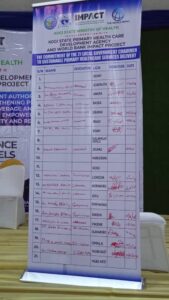
The end of the dialogue was signified by demo-signing of a commitment register by all 21 LGA Chairmen