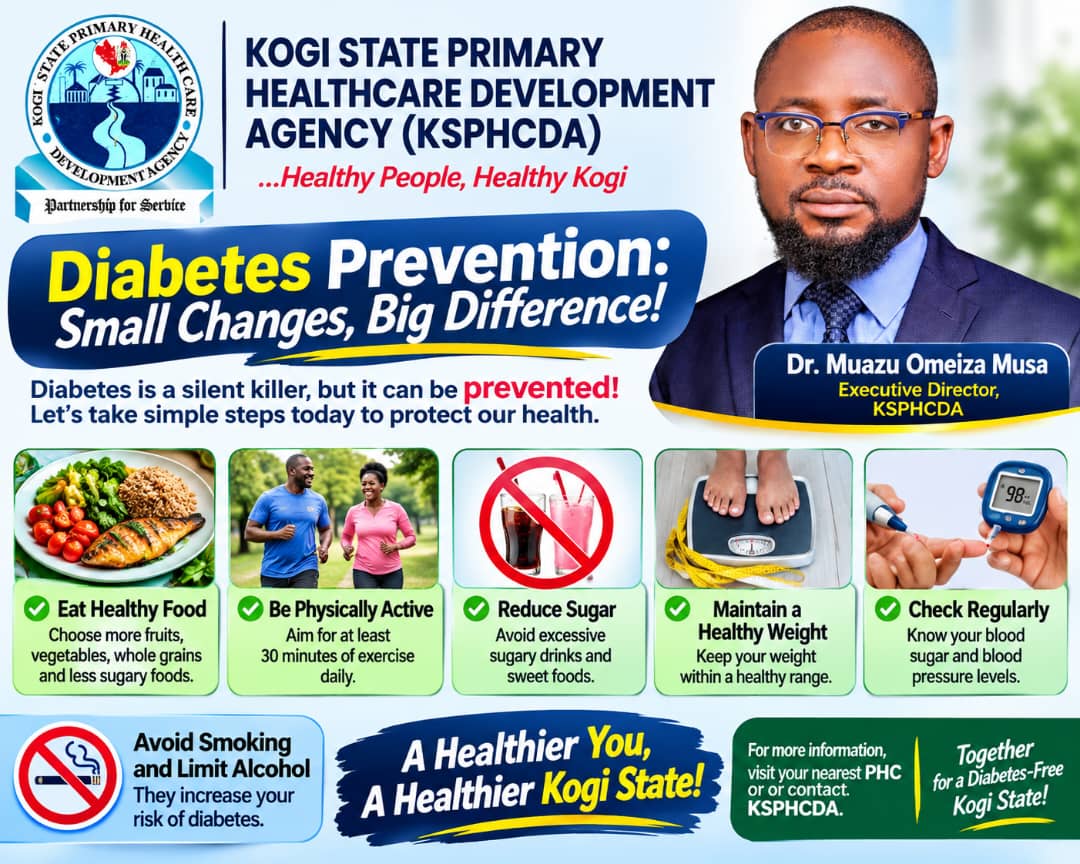
Agency strengthens grassroots prevention, early detection and management of diabetes under Dr. Muazu Omeiza Musa
By Joseph Adama
Diabetes is fast emerging as a major public health challenge, with increasing numbers of people living with the condition without knowing their health status until serious complications begin to manifest.
In Kogi State, the need to confront this growing challenge through sustained public enlightenment, routine screening, early diagnosis and accessible healthcare services has become increasingly important.
Recognising the dangers associated with undetected and poorly managed diabetes, the Kogi State Primary Health Care Development Agency (KSPHCDA) is strengthening grassroots healthcare delivery to bring awareness, prevention and early detection closer to residents across the state.
At the centre of this effort is the leadership of the Executive Director of KSPHCDA, Dr. Muazu Omeiza Musa, whose emphasis on functional primary healthcare facilities and preventive healthcare services provides an important platform for tackling non-communicable diseases, including diabetes.
Diabetes is a chronic health condition that occurs when the body cannot produce sufficient insulin or effectively use the insulin it produces, resulting in elevated blood glucose levels. Although the condition can be managed, failure to detect and control it early can lead to serious complications, including kidney disease, blindness, cardiovascular diseases, nerve damage and premature death.
Taking Diabetes Prevention to the Grassroots
One of the most effective ways to combat diabetes is to make screening and early detection services accessible to ordinary citizens, particularly those in rural and underserved communities.
In this regard, KSPHCDA’s efforts to strengthen primary healthcare facilities across the state’s 21 Local Government Areas provide a strategic opportunity to identify people at risk, detect elevated blood sugar levels and ensure that affected individuals receive appropriate medical attention.
A significant step in this direction was the distribution of glucometers and test strips to primary healthcare facilities across the 21 LGAs in February 2026. The intervention, supported by the Federal Ministry of Health, was designed to strengthen diabetes screening, detection and management at the grassroots.
At the flag-off ceremony, Dr. Muazu Omeiza Musa explained that each Local Government Area was expected to conduct extensive blood sugar screening at health facilities, while individuals identified with elevated blood sugar levels would receive free monitoring devices to support self-monitoring at home.
The initiative represents an important shift from a healthcare approach that responds only when patients develop complications to one that prioritises prevention, early diagnosis and continuous monitoring.
By making testing equipment available at primary healthcare facilities, residents have greater opportunities to know their blood sugar levels early and seek professional medical guidance before the condition becomes more complicated.
Public Enlightenment and Lifestyle Changes
Beyond the distribution of medical equipment, public enlightenment remains a critical component of the fight against diabetes.
Many residents are still unaware of the risk factors associated with the condition, including excessive body weight, physical inactivity, unhealthy eating habits, family history and advancing age.
Consequently, KSPHCDA has an important role to play in promoting continuous health education that encourages individuals and families to adopt healthier lifestyles.
Through community health workers, healthcare personnel and grassroots mobilisation structures, the Agency can take diabetes awareness directly to the people.
Churches, mosques, markets, schools, motor parks, traditional institutions and community gatherings provide strategic platforms for educating residents about diabetes symptoms, risk factors, preventive measures and the importance of regular blood sugar checks.
Such enlightenment efforts are particularly important because Type 2 diabetes may develop gradually, with some affected individuals experiencing few or no noticeable symptoms in its early stages.
Dr. Muazu Omeiza Musa and the Strengthening of Preventive Healthcare
Under the leadership of Dr. Muazu Omeiza Musa, the Agency’s emphasis on functional primary healthcare facilities provides a strong foundation for expanding the prevention and management of non-communicable diseases across Kogi State.
His directive to Directors of Primary Healthcare across the state to take responsibility for the functionality, supervision and performance of their facilities is particularly relevant to sustaining diabetes screening and other essential health services.
Similarly, Kogi State’s 2025 Annual Operational Plan identified the provision of glucometers, digital blood pressure monitors and essential medicines to 239 primary healthcare centres as part of its response to non-communicable diseases.
The plan also outlined community-based screening for hypertension and Type 2 diabetes across the 21 Local Government Areas.
These policy directions underscore the importance of building a healthcare system that does not merely treat illnesses but actively works to prevent them, identify health risks early and provide continuing care for people living with chronic conditions.
Dr. Musa’s emphasis on supervision, accountability, healthcare worker commitment and facility functionality is therefore significant to the sustainability of these interventions.
Diabetes screening must not be treated as a one-day exercise or an occasional public health campaign. It requires the consistent availability of testing equipment, trained personnel, reliable medical supplies, proper documentation and effective referral arrangements for individuals requiring further medical attention.
The Need for Sustained Public Participation
The fight against diabetes cannot be left to government and healthcare institutions alone. Individuals must also take responsibility for their health by embracing regular medical examinations, maintaining balanced diets, engaging in physical exercise, avoiding tobacco use and limiting excessive consumption of sugary drinks.
People living with diabetes must understand that the condition is manageable when properly diagnosed and treated. They should adhere to prescribed medications, attend follow-up appointments and avoid unverified herbal remedies and self-medication.
KSPHCDA also needs sustained partnerships with professional medical associations, civil society organisations, development partners, traditional rulers, religious leaders and community-based organisations to expand awareness and screening services.
Such collaboration will help address misconceptions, encourage early testing and ensure that residents in hard-to-reach communities are not left behind.
A Healthier Kogi Through Preventive Healthcare
Ultimately, the success of diabetes prevention in Kogi State should not be measured only by the number of glucometers distributed or screening exercises conducted, but by the number of people reached, diagnosed early, linked to appropriate treatment and supported to live healthier lives.
The ongoing efforts of KSPHCDA under the leadership of Dr. Muazu Omeiza Musa provide an important platform for advancing this objective.
With sustained government commitment, effective coordination, adequate resources and active community participation, primary healthcare facilities can become stronger centres for diabetes awareness, early detection and continuing care.
As Kogi State continues to strengthen its healthcare system under the administration of Governor Ahmed Usman Ododo, the message must remain clear: diabetes prevention begins with awareness, early detection saves lives, and accessible primary healthcare makes the difference.
The time has come for every community, household and individual to take diabetes seriously. Knowing one’s blood sugar level is not a luxury; it is an essential step towards protecting health, preserving lives and building a healthier Kogi State.