Five-Day Assessment Targets Gaps as State Prepares for Sustainable Essential Medicines System
By Rotimi Odofin
The looming withdrawal of donor support for Nigeria’s essential medicines supply chain by 2030 has triggered a major readiness assessment in Kogi State, with the Federal Government moving to determine whether the state has the capacity to independently sustain the system.
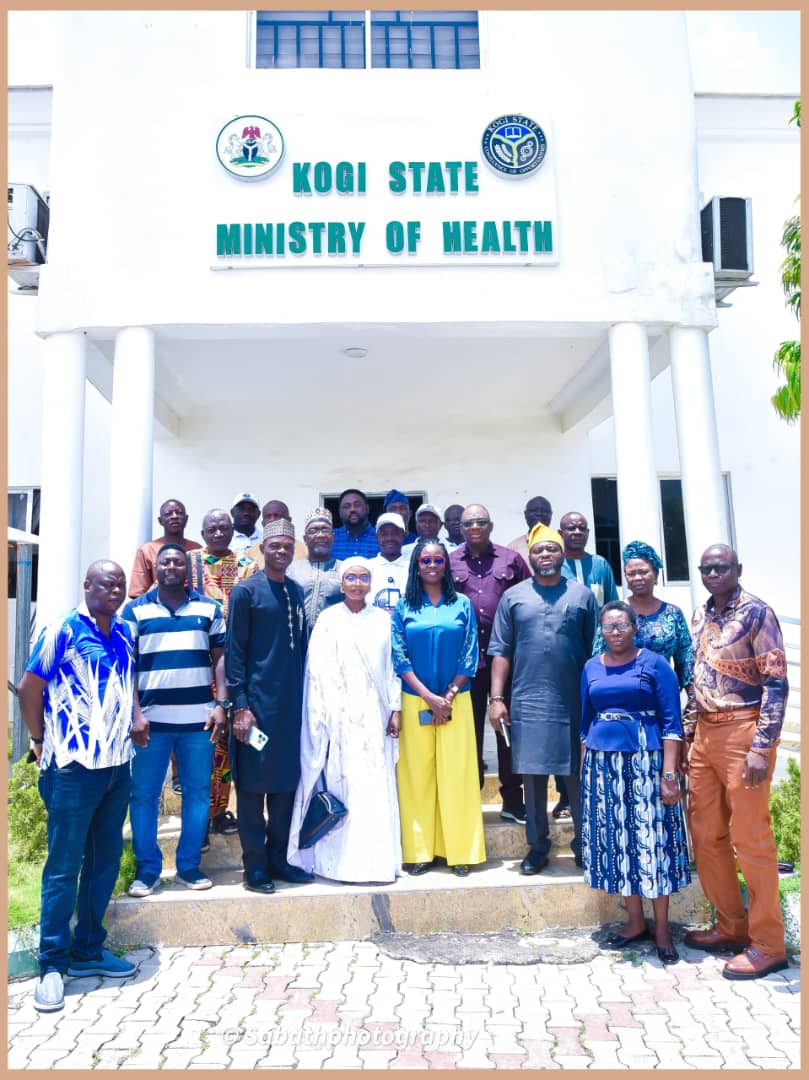
A delegation from the Federal Ministry of Health has commenced a five-day advocacy and assessment visit to Kogi State to evaluate the maturity, strength and sustainability of its pharmaceutical and medical commodities supply chain system.
The exercise is coming against the backdrop of plans by major donor agencies supporting Nigeria’s unified health supply chain system to progressively wind down their interventions, making government ownership and sustainability an increasingly urgent national priority.
The assessment is expected to determine whether Kogi has the structures, systems, manpower and institutional capacity required to take full ownership of the essential medicines supply chain and guarantee uninterrupted availability of quality medicines beyond the donor-support era.

Leading the Federal Ministry of Health delegation, Pharmacist Frances Okosi said the exercise was not merely a routine inspection but a strategic assessment designed to identify the strengths, weaknesses and critical gaps in Kogi’s drug management architecture.
She explained that the unified supply chain system was established to ensure the effective management and distribution of essential medicines from the Federal Government through the states and Local Government Areas down to Primary Healthcare Centres, particularly at the last-mile level.
Okosi said the gradual withdrawal of donor agencies from various components of the supply chain made it imperative for governments at all levels to begin preparing for full ownership of the system.

She stressed that the standards, structures and mechanisms established through years of donor-supported programmes could be sustained by government if the necessary capacity was deliberately built.
According to her, the Kogi assessment would specifically determine the maturity status of the Kogi State Drugs Management Agency and identify areas requiring urgent strengthening to ensure the sustainability of the pharmaceutical supply chain.
Representing the Coordinating Commissioner for Health, Dr. Abdulazeez Adams Adeiza, the Permanent Secretary, Mr. Maji Enoch, assured the delegation that the Kogi State Government was fully prepared to cooperate with the Federal Ministry of Health to achieve the objectives of the exercise.

Enoch said the state recognised the urgent need to develop a resilient pharmaceutical supply chain that could function effectively without excessive dependence on external funding and technical support.
He emphasised the importance of maintaining close collaboration between the state and Federal Government, noting that a coordinated approach was essential to achieving the objectives and standards of the unified supply chain system.
The Permanent Secretary reaffirmed the commitment of Governor Ahmed Usman Ododo’s administration to sustaining support for priority health programmes and policies.
He assured the delegation that any gaps identified during the five-day assessment would be carefully examined and appropriately addressed by the state government.

He said Kogi would not wait until donor support completely disappears before strengthening its systems, stressing that the state was already taking steps to build the institutional capacity required for a sustainable transition.
Providing an insight into reforms within the state’s pharmaceutical supply chain, the Executive Secretary of the Kogi State Drugs Management Agency, Pharmacist Ibrahim Onize Salamat, disclosed that more than 20 pharmaceutical companies currently supply medicines to the agency.
She said the agency had recorded significant reforms aimed at improving efficiency, accountability, quality control and transparency in the management of medicines and medical consumables.
According to her, the state government had renovated one of Drug Revolving Store and effort is ongoing to upgrade the main Warehouse , while the agency had migrated from analogue inventory management to a digital one for visibility and good operational system.
She disclosed that the agency had also intensified quality-control measures through visits to pharmaceutical manufacturing companies to conduct on-the-spot assessments of production processes and good manufacturing practices.

The agency, she added, had embarked on study tours and other technical engagements to learn best practices in pharmaceutical management and supply chain operations.
Salamat, however, acknowledged that the agency was yet to be rated as fully mature under the Federal Ministry of Health’s applicable maturity framework but it’s responsive and emerging.
She stressed that the agency was nevertheless undergoing continuous reforms and strengthening its systems to meet the required standards and attain the desired maturity level.
Salamat also highlighted the establishment of a uniform price regime for medicines across Kogi State as one of the agency’s significant reforms.
She said the initiative was designed to reduce disparities in the prices of medicines between urban and rural areas and promote more equitable access to essential medicines across the state.

She further disclosed that the agency had strengthened its last-mile delivery system, enabling medicines and medical commodities to move beyond central stores to health facilities closer to communities, particularly at the grassroots.
The five-day assessment is expected to provide the Federal Ministry of Health and the Kogi State Government with a clearer picture of the state’s current supply-chain capacity, expose remaining gaps and chart a pathway towards greater sustainability.
For Kogi, the exercise could prove critical as Nigeria approaches the next phase of donor transition.
With donor-funded support gradually moving towards an exit phase, the challenge before the state is clear: to prove that the systems built with external support can survive, expand and deliver essential medicines effectively under government ownership.