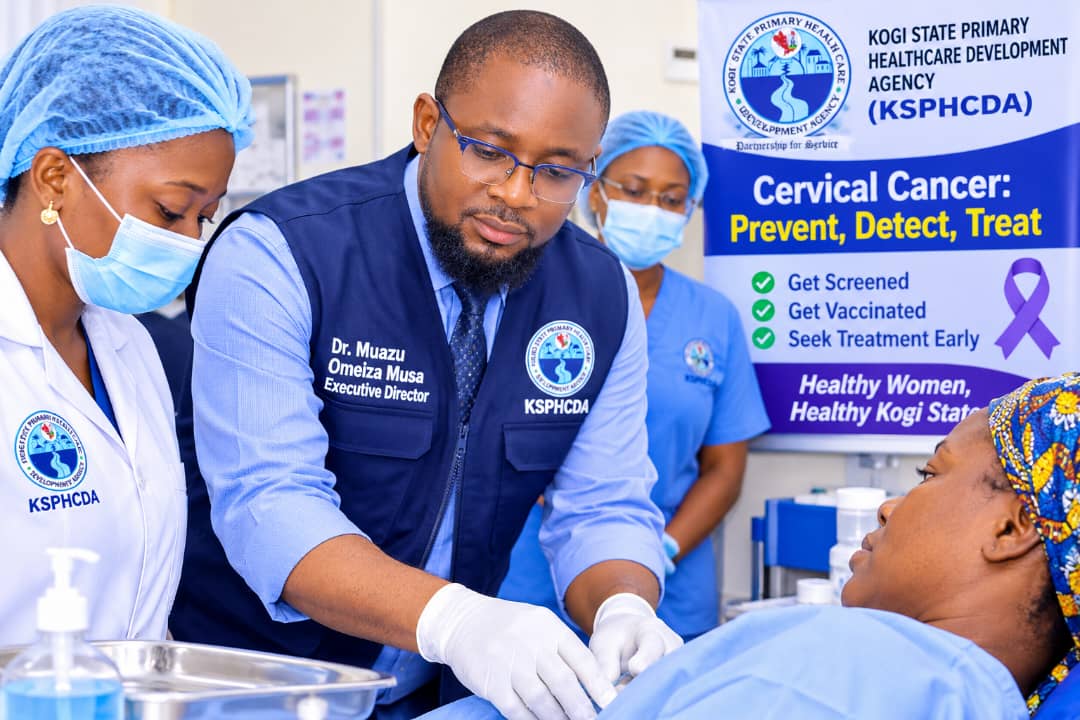
By Joseph Adama
PRO, KSPHCDA
Cervical cancer remains a major public health challenge confronting women globally, particularly in developing countries where limited awareness, inadequate screening, late diagnosis and poor access to treatment continue to contribute to preventable deaths.
However, through sustained investment in primary healthcare, preventive interventions and community mobilisation, Kogi State is strengthening efforts to reduce the burden of the disease, with the Kogi State Primary Health Care Development Agency (KSPHCDA) playing a central role in translating these interventions into grassroots action.
Under the leadership of its Executive Director, Dr. Muazu Omeiza Musa, the Agency has continued to support cervical cancer prevention through Human Papillomavirus (HPV) vaccination, public enlightenment, health-worker capacity development and the integration of preventive healthcare services into routine primary healthcare delivery.
One of the most critical strategies in the fight against cervical cancer is prevention through awareness creation and vaccination. Many women and families remain insufficiently informed about the relationship between persistent infection with high-risk strains of HPV and the development of cervical cancer.
Recognising this challenge, KSPHCDA has continued to utilise its extensive primary healthcare network to promote health education, sensitise communities and encourage families to embrace preventive health interventions.
HPV vaccination: A major milestone
A significant milestone in Kogi State’s cervical cancer prevention efforts was recorded on May 27, 2024, when the state introduced the HPV vaccination programme targeting eligible girls.
The intervention, coordinated by KSPHCDA, represented a strategic shift from responding to cervical cancer after its development to preventing the disease by protecting girls against HPV infection before potential exposure.
The outcome was remarkable. According to figures presented by the Executive Director, Dr. Muazu Omeiza Musa, at the Second Dr. Busayo Emmanuel Agbana Annual Memorial Lecture in February 2025, a total of 284,750 eligible girls were vaccinated, representing 99 per cent coverage of the state’s target population.
This achievement reflected the importance of effective planning, community mobilisation, stakeholder engagement and coordinated implementation in expanding access to preventive healthcare.
Beyond administering vaccines, the Agency recognised that the success of the programme depended largely on public acceptance and community participation.
Consequently, advocacy, communication and social mobilisation activities were undertaken to engage parents, guardians, traditional rulers, religious leaders, healthcare workers and other stakeholders.
These engagements helped address misconceptions, strengthen public confidence and encourage families to support HPV vaccination as an important investment in the future health of their children.
Strengthening healthcare workers and routine immunisation
Another important contribution of KSPHCDA has been the training and capacity development of healthcare personnel to ensure effective implementation of vaccination activities.
The Agency facilitated training for health workers and relevant stakeholders on vaccine handling, safety, management and effective delivery of immunisation services.
In November 2025, Dr. Muazu Omeiza Musa further demonstrated the Agency’s commitment to sustaining the gains of HPV vaccination by calling for intensified vaccination activities during a three-day step-down training on youth-friendly health services in support of HPV vaccination intensification.
The training reinforced the need to equip frontline health workers with the knowledge and skills required to reach eligible girls and provide appropriate health information.
The Agency has also pursued the integration of HPV vaccination into routine immunisation services, recognising that cervical cancer prevention must go beyond periodic campaigns.
This approach provides opportunities to reach eligible girls who may have missed earlier vaccination exercises through appropriate routine immunisation platforms.
In furtherance of this commitment, KSPHCDA, in collaboration with the Kogi State Ministry of Health and development partners, participated in the 2025 Integrated Measles-Rubella, Polio and HPV Vaccination Campaign.
The campaign, flagged off by Governor Ahmed Usman Ododo, provided another opportunity to expand immunisation coverage and protect eligible girls against HPV infection.
Similarly, the Agency’s participation in the Integrated Maternal, Newborn and Child Health Week, HPV Vaccination and Safe Motherhood activities in July 2025 further demonstrated its commitment to bringing essential preventive healthcare services closer to families.
Extending interventions to underserved communities
The commitment to expanding access to preventive healthcare was further demonstrated on June 25, 2026, when Kogi State flagged off another round of the Integrated Maternal, Newborn and Child Health Week, HPV Vaccination and Neglected Tropical Diseases Campaign.
Through KSPHCDA and the Ministry of Health, with support from development partners including the World Health Organisation (WHO), UNICEF and Sightsavers, the state intensified efforts to extend essential healthcare interventions to underserved populations.
The activities targeted communities and population groups that often face geographical and other barriers to accessing healthcare, including remote settlements, riverine communities, markets and schools.
These interventions underscore the importance of taking healthcare services directly to the people, particularly vulnerable populations who may otherwise be excluded from routine health programmes.
Why screening remains important
While HPV vaccination is a critical preventive intervention, vaccination alone cannot eliminate the existing burden of cervical cancer.
Women within the recommended screening age must also have access to regular cervical cancer screening, irrespective of their vaccination status.
This is because HPV vaccines prevent new infections from targeted cancer-causing HPV types but do not treat existing infections or cervical abnormalities.
Consequently, KSPHCDA has an important role in promoting screening awareness, strengthening referral pathways and encouraging women to access appropriate services at designated healthcare facilities.
The free HPV screening reported at Prince Abubakar Audu University Teaching Hospital in 2025 also provided an opportunity for women to benefit from early detection services.
Early detection is particularly important because precancerous cervical changes can often be identified and treated before they develop into cancer.
The Agency’s broader responsibility, therefore, extends beyond protecting young girls through vaccination to ensuring that adult women are informed about screening and can access timely diagnosis and treatment.
Breaking stigma through community engagement
Another challenge confronting cervical cancer prevention is the stigma and misconceptions associated with reproductive health issues.
Some women may hesitate to seek screening or medical attention because of fear, embarrassment, misinformation or the possibility of discrimination.
Through sustained health education, community engagement and collaboration with traditional and religious institutions, KSPHCDA can continue to promote open conversations about cervical cancer and encourage women to seek healthcare without fear or shame.
The message must remain clear: cervical cancer is largely preventable, screening saves lives, and women who require medical attention deserve compassionate and timely care.
The road ahead: Sustaining the gains
The efforts of KSPHCDA align with the broader health-sector priorities of Governor Ahmed Usman Ododo’s administration, particularly the drive to strengthen primary healthcare delivery and expand access to essential health services across Kogi State.
However, sustaining the reported 99 per cent HPV vaccination coverage will require continuous monitoring, adequate vaccine supplies, routine immunisation, regular training of health workers, expanded screening services and effective referral systems.
Particular attention must also be given to girls in hard-to-reach communities and women who face financial, social or geographical barriers to accessing healthcare.
The fight against cervical cancer is not the responsibility of government alone. Parents must ensure that eligible girls receive HPV vaccination; women must take screening seriously; healthcare workers must provide accurate information and compassionate services; while community and religious leaders must help dispel myths and encourage preventive healthcare.
Ultimately, the contribution of Kogi State Primary Health Care Development Agency, under the leadership of Dr. Muazu Omeiza Musa, demonstrates the importance of coordinated public health action in reducing the future burden of cervical cancer.
The vaccination of 284,750 eligible girls, representing 99 per cent of the target population, remains an important milestone in the state’s preventive healthcare efforts.
But the ultimate goal must go beyond impressive vaccination figures to building a healthcare system where women can access screening, early diagnosis and appropriate treatment without unnecessary barriers.
Kogi State’s experience underscores what sustained investment in primary healthcare, effective community mobilisation and partnership with development organisations can achieve.
The message is simple but urgent: Vaccinate eligible girls, screen women, detect early, treat promptly and save lives.