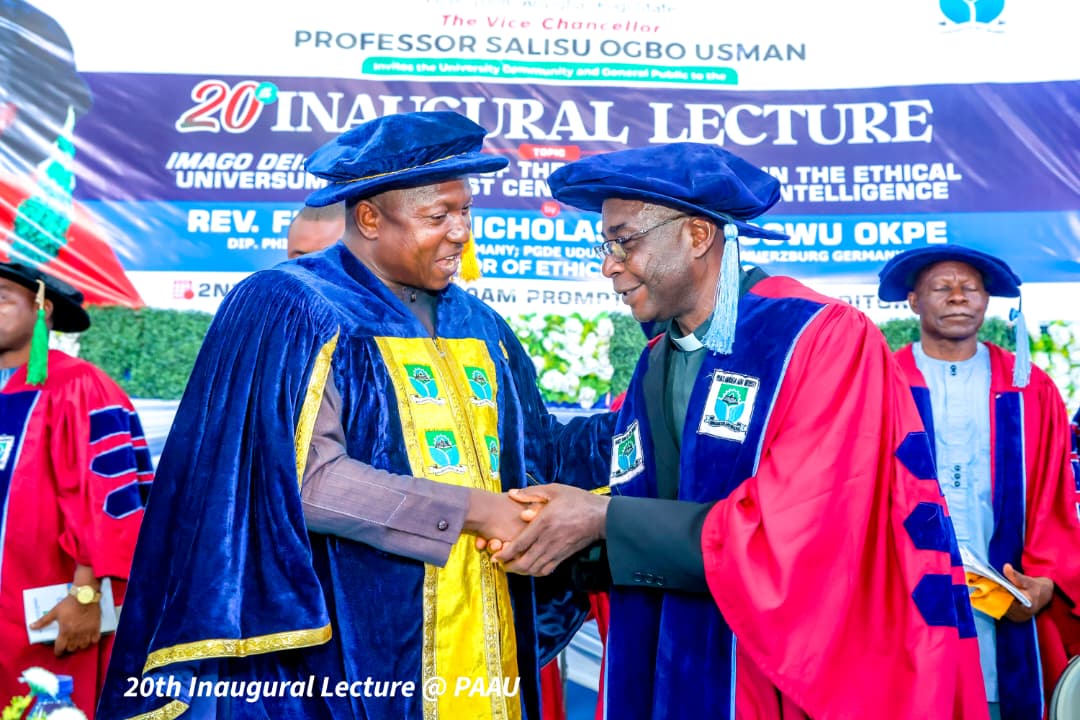
Professor of Ethics and Values, Rev. Fr. Professor Nicholas Ojoajogwu Okpe, has called for the protection of human dignity as the foundation for the ethical development and deployment of Artificial Intelligence (AI).
He made the call at the 20th Inaugural Lecture of Prince Abubakar Audu University, Anyigba, titled “Imago Dei: The Dignity of the Human Being in the Ethical Universum of 21st Century Artificial Intelligence,” held on Tuesday, 2nd June, 2026, at the University Auditorium, where he examined the ethical, philosophical and theological implications of emerging artificial intelligence technologies on humanity.
In his presentation, Prof. Okpe explained that technological innovations throughout history had consistently challenged humanity’s understanding of itself, noting that the emergence of Artificial Intelligence represents one of the most significant ethical and anthropological questions of the modern era.
He described “Imago Dei” as the Christian belief that human beings are created in the image and likeness of God, stressing that this unique status gives every person inherent dignity, worth and moral responsibility.
In his words, any meaningful discussion on artificial intelligence must begin with a proper understanding of the human person, emphasizing that human dignity cannot be reduced to utility, performance or technological efficiency.
The inaugural lecturer identified conscience as an indispensable moral compass that guides ethical decision-making, arguing that intelligent machines, regardless of their capabilities, cannot replace human moral responsibility and accountability.
Prof. Okpe traced the evolution of Artificial Intelligence from Information AI and Agentic AI to Physical AI and the emerging concept of Conscious AI, highlighting both the opportunities and risks associated with increasingly autonomous technologies.
He warned that AI poses significant threats to human dignity through the instrumentalisation of persons, erosion of autonomy, surveillance, invasion of privacy, economic displacement, algorithmic bias and the blurring of distinctions between humans and machines.
Drawing from theological, philosophical and ethical perspectives, Prof. Okpe emphasized that artificial intelligence must be developed and governed within frameworks that prioritize justice, transparency, accountability, human rights and the common good.
He further stressed that technology should remain a servant of humanity rather than its master, insisting that whenever conflicts arise between efficiency and human dignity, dignity must prevail.
The inaugural lecturer advocated a global ethical and spiritual dialogue involving theologians, philosophers, scientists, policymakers, technology developers and community leaders to collectively shape a human-centred future for artificial intelligence.
He concluded that the future of AI should focus on enhancing human creativity, wisdom, justice and compassion, while preserving the sacred worth of every human.
Earlier, the Chairman of the Inaugural Lecture Committee, Prof. Sunday Salifu Arogba, congratulated the inaugural lecturer on attaining the prestigious academic milestone.
In his address, the Vice-Chancellor of the University, Professor Salisu Ogbo Usman, described the lecture topic as timely, relevant and intellectually compelling, noting that Artificial Intelligence had become one of the most transformative technologies of the 21st century with implications for education, healthcare, governance, security, business and scientific research.
He stated that the lecture reinforced the responsibility of universities to provide intellectual leadership on emerging global challenges and commended Prof. Okpe for his scholarly contributions to ethical discourse and character formation.
The Vice-Chancellor also appreciated the Chairman and members of the Inaugural Lecture Committee for sustaining the University’s culture of scholarship and intellectual engagement.
Highlight of the event was the presentation of the inaugural lecture certificate, plaque and medal to the lecturer.
The lecture attracted members of the University Management, Senate, academic staff, students, Royal fathers, religious leaders and distinguished guests from within and outside the University community.