


 By Abah Benjamin Eneojoh
Lokoja, Kogi State
January 16, 2026
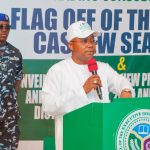
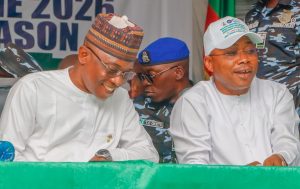
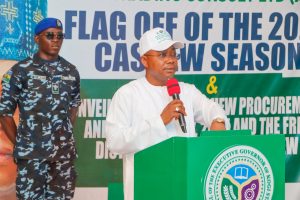
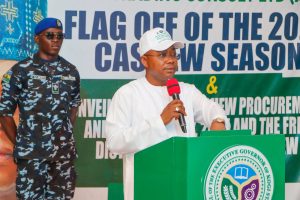
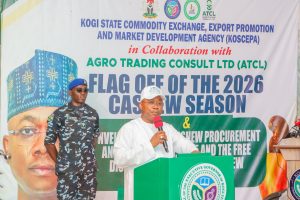
The Executive Governor of Kogi State, His Excellency Alhaji Ahmed Usman Ododo, FCA, on Thursday flagged off the 2026 Cashew Production and Marketing Season at the Glass House, Government House, Lokoja, describing the moment as a defining turning point in the state’s agricultural and economic transformation agenda.
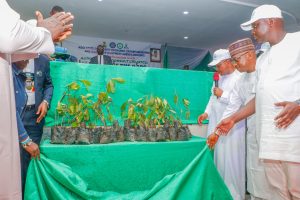
The event, which combined three landmark activities, featured the official flag-off of the 2026 Cashew Season, the unveiling of the Kogi State Cashew Procurement and Trade Policy 2025, and the launch of the free distribution of hybrid cashew seedlings to registered and verified farmers across the state.
Governor Ododo, in his remarks, emphasized that cashew remains one of Kogi State’s most valuable natural endowments, lamenting the persistent failure to fully appreciate and protect its immense economic potential.
“Cashew has various forms of units and uses. We have food uses, medicinal uses, industrial uses, agricultural and environmental uses, economic uses, and even cosmetic uses,” the Governor said.
He explained that cashew is used in the production of insecticides, pharmaceuticals, and health-enhancing products, while cashew trees help prevent soil erosion and provide sustainable income for farmers.
“When you know all of this, do we value ourselves? Do we value what God has given us?” Governor Ododo asked, expressing concern that many beneficiaries of the cashew economy are outsiders, while locals fail to organize and defend their interests.
“They are here watching. Most of them are not from this state; they have just come to work here,” he added, warning that lack of unity and self-sabotage continue to undermine the state’s economic progress.
Welcoming stakeholders to the gathering, the Director-General of the Kogi State Commodity Exchange, Export Promotion and Market Development Agency (KOSCEPA), Hon. Adewale Victor Omofaiye, said the programme reflects a deliberate policy direction that places agriculture, structured markets, and commodity development at the centre of Kogi State’s economic growth strategy.
He noted that the Cashew Procurement and Trade Policy, which came into effect on November 28, 2025, provides a clear regulatory framework aimed at strengthening productivity, quality control, market access, and value retention within the state.
Hon. Omofaiye recalled that upon assuming office in 2024, Governor Ododo recognized Kogi State’s strategic position as a major hub for agricultural commodities, particularly cashew, which enjoys strong global demand. This realization led to the establishment of KOSCEPA to expand exports, promote value addition through processing, packaging and branding, create jobs, and boost revenue generation.
Highlighting the global context, Omofaiye noted that Nigeria ranks as the world’s fourth-largest cashew producer, with an annual output of about 450,000 metric tonnes and export earnings exceeding 700 million dollars. He stressed that Kogi State is the backbone of this performance, accounting for an estimated 40 percent of national output.
According to him, Kogi State’s annual production for the 2024–2025 season is estimated at about 350,000 metric tonnes, with cashews meeting high international quality standards, including Kernel Output Ratios of 49 to 50 and moisture content of approximately 8 percent.
To sustain this leadership and expand Nigeria’s global market share, the state government has set a clear target for planting new cashew trees, a goal being actively pursued through the free distribution of hybrid seedlings launched at the event.
The newly unveiled Cashew Procurement and Trade Policy introduces strict quality and market regulations, including the mandatory use of approved jute bags for packaging. Omofaiye warned that Violations will attract fines and possible confiscation of produce.
The policy also prohibits foreign buyers from directly hijacking produce at farm gates. Henceforth, foreigners may only transact through registered and government-approved agents, supported by proper documentation.
“These measures are designed to protect farmers, stabilize prices, and ensure transparency and fairness in the cashew trade,” Omofaiye said, adding that the policy will be reviewed every three years to reflect changing market realities.
The government is also actively encouraging private investors to establish cashew processing plants within the state, a move expected to reduce post-harvest losses, improve product quality, create employment opportunities, and ensure that a larger share of the cashew value chain remains in Kogi State.
Governor Ododo reaffirmed his administration’s commitment to policies that empower farmers, strengthen local capacity, and reposition Kogi State as a dominant force in Nigeria’s agricultural export economy.
“This programme is about productivity, quality, market access, and shared prosperity,” Omofaiye concluded. “It is about building a structured cashew economy that works for Kogi State and Nigeria at large”
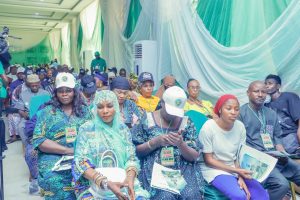
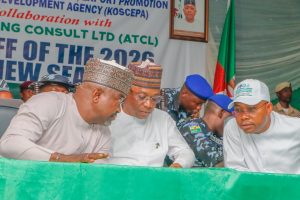
The ceremony was attended by government officials, traditional rulers, farmers’ associations, who described the initiative as a bold step toward sustainable agricultural growth and economic self-reliance.