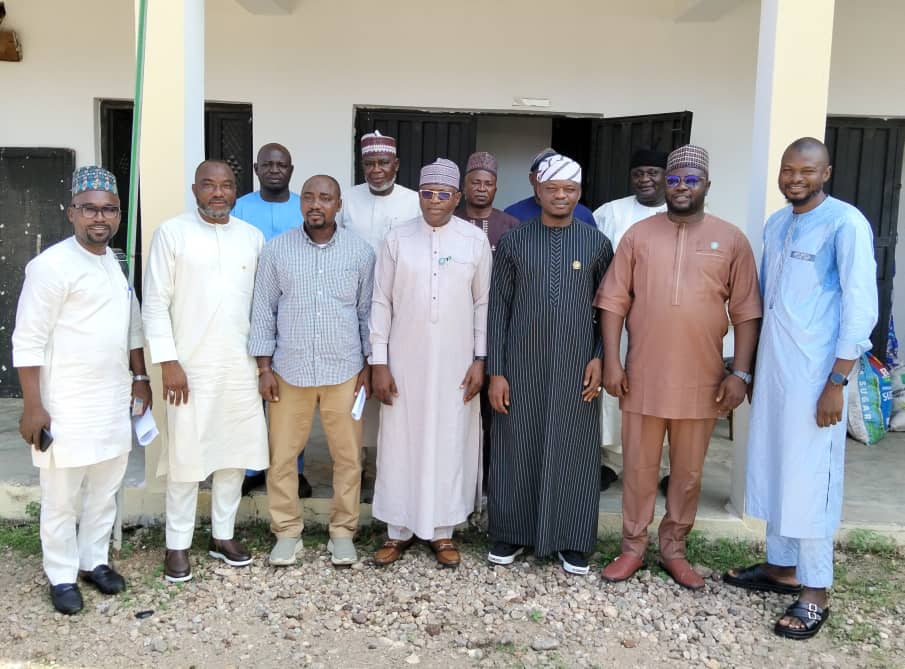
The Kogi State Fiscal Responsibility Commission has announced the successful passage and commencement of the Fiscal Responsibility Law 2026 (as amended), marking a major milestone in strengthening fiscal discipline, transparency, and accountability in the state’s financial management system.

The Chairman of the Commission, Mallam Jimoh Muhammed, disclosed this during the Commission’s management meeting convened to brief stakeholders on the outcome of the recently concluded review and amendment of the law.
According to the Chairman, the amended law has been duly passed by the Kogi State House of Assembly and assented to by His Excellency, Governor Ahmed Usman Ododo, taking effect from March 13, 2026.
Mallam Muhammed expressed profound gratitude to God Almighty for the successful review process and commended Governor Ododo for his unwavering commitment to fiscal discipline and good governance.
“The prompt assent to this law demonstrates His Excellency’s strong commitment to fiscal responsibility and prudent financial management.

This administration has shown determination in enforcing sound fiscal policies, evident in the impactful projects executed across the state,” he stated.
He further appreciated key government officials, including the Commissioner for Finance, Budget and Economic Planning, Hon. Asiwaju Idris, the Accountant-General of the State, Hajia Habitat Onumoko Tijani, the Attorney-General and Commissioner for Justice, Hon. Muizudeen Abdullahi, and the Commissioner for Information, Hon. Kingsley Femi Fanwo, for their invaluable support and collaboration throughout the review process.

The Chairman noted that the review became necessary due to significant economic and policy changes since the enactment of the previous law in 2012, which had become outdated and insufficient to address current fiscal realities.
Highlighting key
improvements in the amended law, Mallam Muhammed explained that:
The law has been expanded from 27 to 57 pages, reflecting broader scope and relevance.
It strengthens oversight of borrowing by both state and local governments to ensure proper coordination and accountability.
*It introduces clear borrowing conditions, including mandatory cost-benefit analysis and restriction of loans to capital and infrastructure projects.
*It establishes penalties for violations, with fines that may reach up to ₦10 million.
*It provides for improved funding mechanisms for the Commission.
*It recommends the creation of a State Stabilization Account to enhance financial resilience and reduce dependence on borrowing.
He added that the amended law empowers the Commission to effectively monitor and enforce fiscal policies across government institutions and local government councils, thereby promoting transparency and sustainable economic management.
Mallam Muhammed emphasized that the implementation of the law would position Kogi State as a fiscally responsible and investment-friendly destination.
“With this law now in place and accessible globally, investors and development partners will have greater confidence in the state’s financial governance framework,” he noted.
In their separate contributions, the Director of Monitoring and Evaluation, Mr. Bello Joseph; the Legal Adviser, Mrs. Babatimehin Omolara, Esq.; and the Director of Planning (Policy and Strategy), Mallam Abubakar Musa, Mallam Saeed Abdullahi (Ag. Director Planning, Research & Statistics) emphasized the need for sustained sensitization and advocacy, deeper stakeholders engagements, and the importance of opening a dedicated account to strengthen the financial operations of the state.
In his vote of thanks, Prince Emmanuel Ayo commended the Chairman for his resilience. He appreciated participants for their cooperation, urging them to remain committed and do even more in advancing the Commission’s mandate.
The Chairman called on management staff and stakeholders whom he described as the “foot soldiers” of the Commission to support the implementation process through strategic collaboration, dedication, and innovative ideas.
He emphasized that the next phase would focus on developing actionable strategies to ensure the effective enforcement of the law and achieve the Commission’s mandate.
“The responsibility is now on us to translate this law into measurable impacts. We must work together to ensure its successful implementation for the benefit of Kogi State,” he concluded.